LEAN: A Lightweight and Scalable Attention Network for ECG Age Estimation as a Marker of Cardiovascular Health
To appear in International Conference on Digital Image Computing: Techniques and Applications (DICTA), 2026
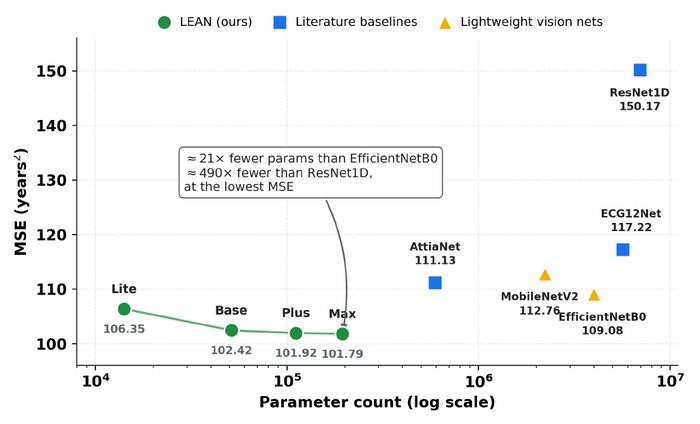
An electrocardiogram (ECG) is a widely used noninvasive test for diagnosing cardiac disease. Recent work has established that the gap between a neural-network-derived ECG age and the chronological age is a useful measure of cardiovascular well-being. However, most ECG age estimators reuse networks built for disease diagnosis, and these tend to be computationally heavy and difficult to scale. We propose LEAN, a lightweight and scalable hybrid of convolution and self-attention for efficient ECG age estimation. LEAN extracts features through a shallow backbone of ECGNext blocks and then applies a self-attention block that supplies the long-range receptive field the shallow backbone cannot reach on its own. A multi-shot inference scheme further refines each prediction by averaging over several crops of the recording. Furthermore, a healthy-reference analysis shows that LEAN-derived ECG age gaps provide a disease-associated aging marker, with pathological recordings appearing approximately four years older than healthy recordings across multiple cardiac conditions. LEAN is instantiated as a family of variants, so a practitioner can match the model to the available computational budget. Its smallest variant, LEAN-Lite, surpasses the strongest existing ECG age estimation network by 4.3% in MSE while using 42× fewer parameters, and the family as a whole attains accurate age estimation at a small fraction of the memory and computation of prior models, making it deployable on resource-constrained point-of-care devices for cardiovascular screening.