Directional Navigability Estimation from Ultra-Low-Resolution Multi-View Thermal Sensing
To appear in IEEE International Conference on Visual Communications and Image Processing (VCIP), 2026
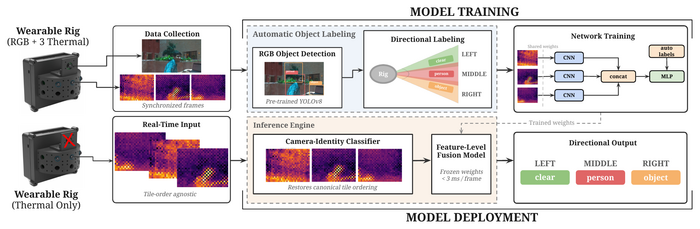
Wearable navigation systems typically depend on high-resolution cameras, depth sensors, and large annotated datasets, a dependence that limits their deployability in privacy-sensitive indoor environments and raises development costs. This paper investigates whether directional navigability can be estimated solely from ultra-low-resolution thermal imagery captured by a wearable multi-camera platform. We propose a learning framework in which high-resolution RGB imagery, available only during data collection, automatically generates navigability labels through a pretrained object detector, eliminating manual annotation. Unlike conventional cross-modal approaches, the framework uses only coarse geometric alignment for automatic labeling and requires no geometric calibration at inference. Experiments with three 32 × 24 thermal cameras show that directional navigability is reliably inferred from thermal input alone and that feature-level fusion outperforms per-camera prediction as well as pixel- and decision-level fusion. A lightweight camera-identity classifier restores near-oracle accuracy when the input ordering changes, and every fusion architecture runs in under 3 ms per frame on CPU. These results suggest that ultra-low-resolution thermal sensing can serve as a scalable and privacy-preserving foundation for wearable indoor navigation.